Views: 7
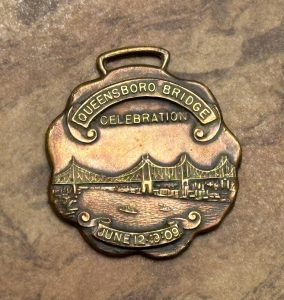
Queensboro Bridge grand opening celebration June 12-19 1909 souvenir fob for a pocket watch Courtesy of Michael Perlman.
By Michael Perlman
Among the significant architectural and engineering achievements in the name of Queens history is the landmarked Queensboro(ugh) Bridge, and besides the frequently visualized Unisphere, it is a great symbol of Queens. Periodically, rare local and Queenswide memorabilia appear on eBay, and since 2002, this columnist has established an archive. A couple of weeks ago, a scarce brass fob appeared, and is now part of the collection. The intricate medal was designed for the June 12 to June 19, 1909 grand opening celebration of the Queensboro Bridge, and was likely worn on a pocket watch by one of your ancestors. This opened up a treasure trove of history, linking ancestral voices to current generations that have stories to share.
The Department of Transportation estimates an average of 129,874 vehicles, 7,568 cyclists, and 2,785 pedestrians navigating the bridge daily. As the bridge moves residents and tourists around for generations, the fob has an intriguing journey of its own. It was 117 years ago when the medal was worn in New York, and somehow ended up in Texas, and now traveled back east to Forest Hills. “If only items could talk… the stories they could tell,” said eBayer Geni Barnes (genifenway10) of East Berlin, Pennsylvania, who sold the medal. “I was searching auctions, and found this fob with others in a Fort Worth, Texas auction. It came from a huge collection.”
The Queensboro Bridge, constructed in eight years, opened for service on March 30, 1909, and early on, accommodated two pedestrian walkways, two trolley lines, horse-drawn carriages, automobiles, and two elevated railway lines. It was the first bridge specifically built for automobiles. This picturesque Beaux Arts treasure was a significant engineering feat, recognized for its double cantilever truss design, and achieved a record as the longest cantilever bridge in America. It was also recognized on a grand opening postcard, published by the Tribune Building as “The greatest cantilever in the world.” From East 59th Street across the East River and Blackwell’s Island to Long Island City, the length was noted as 7,636 feet, with the length of the Queens approach as 2,672 feet and the Manhattan approach as 1,052 feet. Its weight is 83,400,000 pounds. The contract for masonry pier was official on June 1, 1901, and the bridge structure in November 1903.
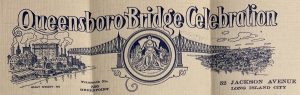
Elaborate Queensboro Bridge Celebration logo, Courtesy of Michael Perlman.
Much gratitude is owed to numerous faithful creative visionaries that were high achievers, including architects George Carnegie Palmer and Henry Hornbostel, Commissioner of Bridges Gustav Lindenthal, and engineers Leffert L. Buck, Samuel R. Probasco, Richard S. Buck, and Othniel Foster Nichols. The builder was the Pennsylvania Steel Company. While under construction, the bridge was known as the Blackwell’s Island Bridge, after a former name of Roosevelt Island, but property owners and civic organizations in Manhattan and Queens petitioned for the Queensboro Bridge naming, to eliminate a negative affiliation with the island’s penitentiary and insane asylum.
Among the unique hand-colored lithograph postcards depicts add-ons in the form of a man and a woman in traditional attire, where she is standing in Long Island City and gracefully extending outreach, as he begins to walk across the bridge. It is titled “Welcome To Our City,” alongside subtitles “Congested Manhattan” and “In Queens There’s Room for All.” Besides the bridge being featured on numerous postcards and photos, it was depicted on unique items such as a Bloomingdale’s 1872 – 1915 commemorative souvenir spoon. This columnist also acquired an assemblage of Queensboro Bridge construction and post-completion photos from the early 1900s. These scenes were photographed by the preeminent firm, Brown Brothers, the earliest U.S. stock photo licensing agency, founded by Arthur and Charles Brown in NYC in 1904 as a news photography service. These photos exist as a single entity or as a few of a kind, and makes an individual feel as if they are standing on the dock alongside families who witnessed its construction.
The civic mentality and teamwork between planners and residents resulted in week-long grand opening festivities, as well as the bridge’s development, which can be a model for successful communal achievements of today. Today’s residents must wonder if their ancestors are responsible for the bridge, or planning or attending the extravaganza. The Queensboro Bridge Celebration’s president was William H. Williams, Jr, the Finance Committee chairman was G. Howland Leavitt, and the secretary was A.H. Humpheries. Fifteen vice-presidents included Louis Windmuller, F.A. Schermerhorn, E.V.W. Rossiter, Morgan O’Brien, and Lawrence Gresser. The Executive Committee consisted of nearly 130 devoted members, with respected names including Samuel J. Bloomingdale, Joseph P. Day, George E. Blackwell, Charles H. Steinway, George C. Meyer, John L. Wyckoff, Maximilian Morgenthau, and William K. Vanderbilt, Jr. The celebration headquarters was located at 52 Jackson Avenue, Long Island City.
An original typed letter featuring an elaborate Queensboro Bridge logo and signed by the secretary on March 8, 1909 is in this columnist’s possession. An excerpt read, “Board of Trade, Ozone Park, L.I., Gentlemen: – In connection with this celebration, it is desired to form a committee which shall represent all the Civic Organizations in Queens County for the purpose of organizing and carrying out a section of the parade which will be one of the features of the Celebration. This parade will take place on Saturday, June 12 and every Civic Association is invited to send representatives to a meeting to be held here on March 11 at 8 P.M.”
Another souvenir was an official program titled “Queensboro Bridge Celebration,” which included early Queens history and on-site transportation. An excerpt read, “Probably the first communication across East River between Manhattan and the lands now composing Queens was by means of the canoes of the Canarsie Indians. Then, in 1638, William Kieft, Director-General of New Netherland, made peace with the Indians and completed by purchase from the Canarsies the title of the West India Company to most of the lands within the present counties of Kings and Queens.” It later read, “The first ferry by means of which the dwellers in Kings and Queens visited their brethren in Manhattan was a square ended scow, rigged with mast and sails. The fare charged for a horse was one shilling and a wagon cost five. This ferry was in operation in 1735, and a quarter of a century passed before it was improved upon. The improvement consisted of a horse boat, a twin boat with a wheel in the center, propelled by a horizontal treadmill worked by horses. This was an eight horse power boat, which crossed the river in from twelve to twenty minutes.”
The bridge served as a catalyst for an increase in Queens’ demographics and the development of factories, office buildings, small businesses, houses, and apartment buildings. It also boosted mobility to neighborhoods, which once consisted of farmland and frame houses, including Forest Hills. That is where social and recreational clubs would be established, including the West Side Tennis Club, which acquired property in 1913. Queens Boulevard, formerly Hoffman Boulevard, consisted of trolley tracks, which were linked from the bridge. The trolley operated from 1909 until 1957, and also served Astoria, College Point, Flushing, and Corona. The Green Bus Lines was incorporated in 1925, and is now the MTA’s Q60, which continues to link Queens Boulevard to Manhattan.
The voice and spirit of the planners also comes alive by reading early articles of The Brooklyn Daily Eagle, in addition to The Newtown Register. The December 31, 1908 edition of the latter featured a letter by Executive Committee member Waldron Williams, who was a countrywide car expert and Chair of the Bureau of Tours of the Automobile Club of America. An excerpt read, “The Queensboro Bridge, with special arrangements for automobiles, will be the only bridge that has the convenience in the country. It will be a precedent for other bridges elsewhere. The automobile has come to stay. It is getting every day more and more essential, even in commercial life. It is part of the economy now of every day business life, as well as a means of pleasure, and the authorities, who are responsible for auto conveniences on the Queensboro Bridge, deserve a large meed of praise.” He also wrote, “The Queensboro Bridge is what the automobile owner has been yearning for. The congestion at the Manhattan terminals of the lower bridges, and the want of special facilities have deterred many motorists from using them. There is always a risk. The facilities offered by the Queensboro Bridge to automobile owners of reaching Long Island easily, will bring them in large numbers to the place. It will also be a positive pleasure to the spectators on the promenade to watch the cars going to and fro on the lower deck of the bridge.”
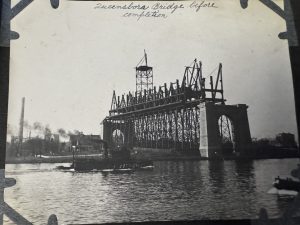
Queensboro Bridge under construction Courtesy of Kat Cattersons late grandparents’ family collection.
Williams later explained, “The benefits that Long Island will derive from the Queensboro Bridge, and the automobile are incalculable. With auto cars spinning around on the good roads all over the Island, the business of the Island will materially increase, and property will be enhanced in value. It will bring large sums of money that are now going elsewhere.” He also pointed out that there will be lines of automobile coaches established as soon as the bridge is opened. “Visitors will be taken to the Island and shown the beauty of this natural garden of Greater New York, and this will stimulate realty transactions and build up large communities,” he said.
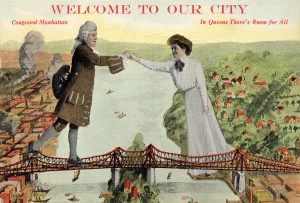
Queensboro Bridge drawing connections to Queens postcard, circa 1909, Courtesy of Michael Perlman’s collection.
In November 1908, Samuel J. Bloomingdale, son of Bloomingdale’s co-founder told The Brooklyn Daily Eagle, “Queens County and particularly those sections of it close to where the bridge terminates, contains hundreds and thousands of acres of undeveloped land – beautiful undulating land with groves, meadows and picturesque spots. It will be impossible to develop all this land in a year, two years or even a decade. Most of this unoccupied land will become the immense playground, breathing spots and recreation places for those immured in tenements and flats in the heart of Manhattan. It will be so near Manhattan that the children can reach it unaccompanied and play ball and enjoy other outdoor and athletic sports, immune from interference of authorities or complaints of busybodies.”
The June 12, 1909 headline of The Brooklyn Daily Eagle stated, “Queensboro Bridge Opening Sounds Awakening of Long Island,” and featured a photo taken from the top of what was considered a tall building on Long Island Shore. The celebration programme largely spanned afternoons and evenings from Saturday, June 12 to June 19, with a June 13th exception. Numerous events were held, and some highlights are as follows: On June 12 at 12:30 PM was a highly festive land parade from 34th Street and Fifth Avenue, up the avenue and across the bridge to Queens County Courthouse. A marine pageant and ceremonies were planned at the reviewing stand. At 8 PM, residents and tourists alike witnessed fireworks and the illumination of Long Island City plaza, accompanied by the opening of a carnival. Then at 8:15 PM, plans called for “The Mocking Bird” comic opera production by a Queens-based company. June 14 featured stadium athletic games at Long Island City Plaza at 2 PM and carnival amusements with electric illumination and outdoor features at 8 PM. June 15 featured a baby parade at 2 PM, and singing by choruses of German and other associations. A June 16 at 2 PM highlight was a 15-mile marathon for amateurs, beginning and concluding at the stadium.
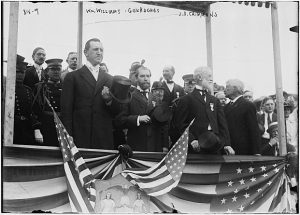
WM. Williams, Gov. Hughes, J.D. Crimmins at the dedication of Queensboro Bridge, June 12, 1909.
June 17 featured an 8 AM motor hunt where cars must return to the plaza of the bridge by 8 PM. June 18 at 2 PM consisted of Old Home Day; gathering of the returning native sons and daughters of Long Island with prominent speakers’ addresses. On June 19 at 2 PM, athletic events were held at the stadium of Long Island City Plaza under the management of P.J. Conway, president of the Irish-American Athletic Association and the Association of Metropolitan Clubs. Another highlight was a grand carnival night at 8 PM, which coincided with a Queensboro Bridge celebration banquet at the original Waldorf-Astoria. Besides “The Mocking Bird” production, the “Queen of Carnival” was crowned on stage between both acts.
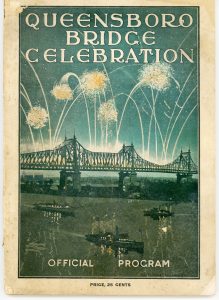
Queensboro Bridge 1909 grand opening program cover Courtesy of bridge climber photographer author Dave Frieder.
Fast-forward to 2026, Queensboro Bridge enthusiasts have many insights to share, as the bridge offers a larger than life spirit over a century later. “The bridge represents Queens, a symbol of where I was born in Astoria, where I went to school, and where I live today,” said Glendale resident Kat Catterson. She is proud to explore her early 20th century family albums, which feature Queensboro Bridge photos, and is open to exhibiting these heirlooms at a museum or historical society. She explained, “My grandfather’s name was James Murray and my grandmother was Winifred (Weindorf) Murray. Arthur Weindorf (1885 – 1979) was her brother from Astoria. I met him a few times, but was very young. Unfortunately, my mother passed, and when I sold my parents’ house, I found artwork from him. I inherited photos from my grandparents.” One of her bridge photos features Arthur during the opening festivities, and he is believed to have taken the photos, in addition to her great-grandfather, William Weindorf. She may also advocate for her great uncle to be recognized with a street co-naming in Astoria.
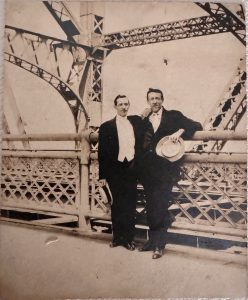
Arthur Weindorf on right, 1909, Courtesy of Kat Catterson.
Spanning 1908 to 1944, Arthur was an architectural designer and engineer for the city’s Public Service Commission, and he collected drawings, clippings, maps, posters, and photos of the subway, according to The New York Historical (Society), where his collection of 259 items was once donated by his daughter. His non-subway creative works were largely exhibited throughout his life.
Catterson takes pride in how the bridge’s iconic status resulted in its numerous appearances in movies and TV shows. Some are “Spider-Man” (2002), the “Taxi” sitcom openings, and the “Look Before You Leap” episode of “Forever.” Additionally, “Queensborough Bridge” is a 1913 watercolor by artist Edward Hopper
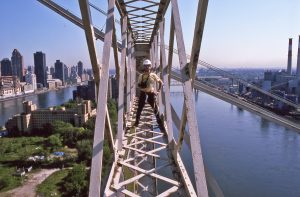
Pennsylvania resident Dave Frieder, who was raised in Flushing and later resided in Closter, New Jersey, is recognized as a professional permit-based citywide bridge climber (as of 1993) and photographer, who authored “The Magnificent Bridges of New York City.” “I made around 105 bridge climbs on 21 bridges (that connect to Manhattan),” he said. As much as the Queensboro Bridge is an innovative feat, his unique talent is a major feat. Martha Stewart, Angela Goethals, and Sigourney Weaver are among the celebrities who own a copy of his book, and a signed copy can be purchased through PayPal: https://davefrieder.com/the-book
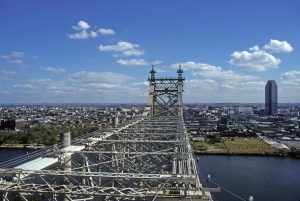
Dave Frieder’s view of Queens while climbing, Photo by Dave Frieder.
Frieder estimates taking hundreds of photos upon climbing the Queensboro Bridge from nearly every angle, and potentially climbing it seven times. His stunning photos capture its architectural beauty and encompasses aerial scenes of Queens and Manhattan alongside sections of the bridge in the 1990s and 2000s. In 2024, JetBlue, which operates at Queens Plaza’s historic Brewster Building, a former automobile and plane assembly plant, displayed his photographs of the Queensboro Bridge in their northwest lobby. “They looked across the internet, found my website, and said, ‘We would like to purchase two of your photos.’” This 1911 building was a first major development sparked by the Queensboro Bridge.
Frieder explained that training and an individual’s form are determinants for bridge climbing, hanging, and crawling. “I would carry 80 pounds of equipment. The Queensboro was the physically most difficult to climb. The I-bars near the tops of the towers are almost at 45 degrees. To get on the lower platforms, I had to use rope to lift the backpacks into certain positions. I had to figure out a lot myself, and luckily the ironworkers taught me a lot in terms of how to grab, climb, and bring stuff to different points. To get to the platforms, I had to climb through the box beams.”
Reminiscing his youth, he said, “Around 1961, when I was 6, my father bought me an Erector set. I always liked engineering. On the East Side, my father’s parents lived, and we would take the FDR Drive south. I would see different bridges across the East River, which fascinated me. I would look up at the Queensboro Bridge’s finials that looked like a queen’s crown and said, ‘I wonder what it would be like climbing them.’ It took me a while, but I did quite a few times.”

Wells Cox is a digital media enthusiast and writer passionate about social media trends and online engagement. As the creator of MT LIVECHAT, he shares insights, tips, and updates to help users navigate the ever-evolving digital landscape.