Views: 5
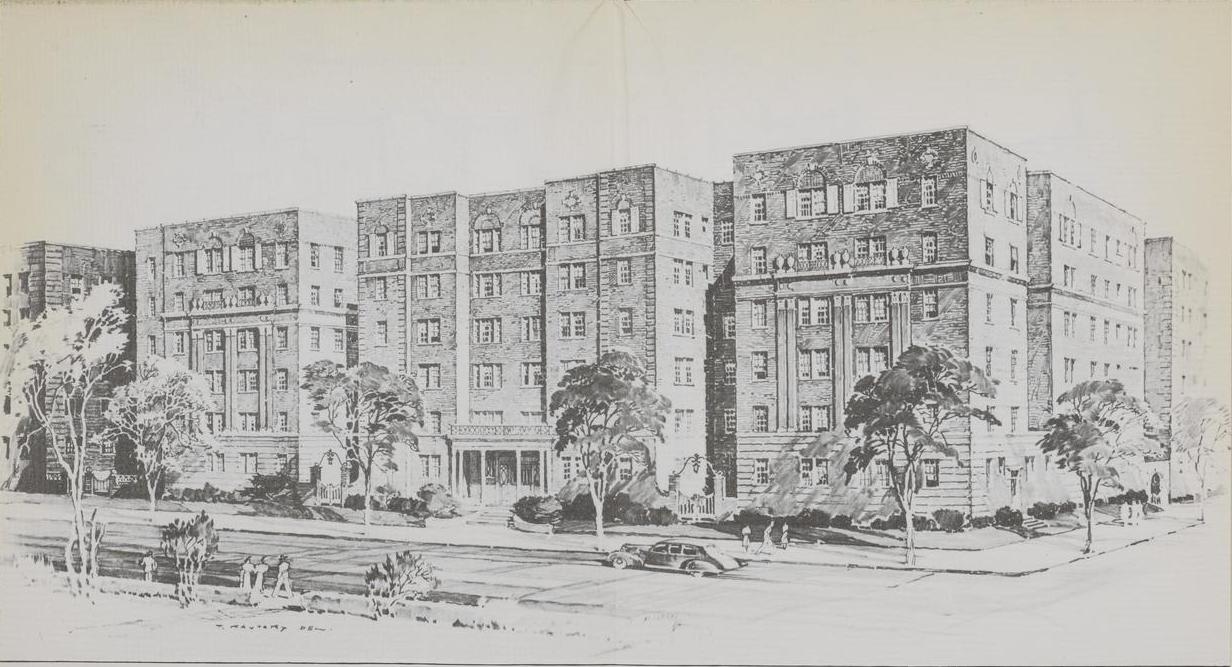
Longfellow Hall, 111-14 76 Avenue
Descendants Preserve Architect Morris Kavy’s Memory
By Michael Perlman
If you live in a Kavy & Kavovitt apartment building in Forest Hills, Rego Park, or perhaps in Brooklyn, Manhattan, or along the Grand Concourse, consider it an honor. This corporate architectural firm was founded by architect and builder Morris Kavy, who achieved an architectural degree from Cooper Union and became a master of the trade. He went the extra mile to ensure that buildings with distinctive façades and interiors, often bearing Colonial or English design, would make residents feel at home and boost their quality of life.
During the Great Depression (1929 -1939), New Yorkers faced significant rates of unemployment, poverty, and housing loss. After the 1936 IND subway line’s completion and in anticipation of the 1939 – 1940 World’s Fair, Forest Hills and Rego Park were among the neighborhoods experiencing a development boom. In December 1938, Morris Kavy discussed the growth of an apartment trend with The New York Sun: “Thus for the first time in recent years, our clients have been inclined to ‘rush’ the season. In the past month, we have filed plans, and we are now preparing plans for apartments which will have an aggregate value of well over $3,000,000 when completed, and which will provide quarters for well over 700 families.” Plans encompassed residences in Forest Hills, Long Island City, Jackson Heights, and the Kings Highway, Ocean Avenue, and Borough Park sections.
All regal Forest Hills and Rego Park buildings designed by Kavy & Kavovitt survive, but many merit restoration and the replication of lost features, frequently pertaining to their pilaster entrances, doors, transom windows, and ornamental shutters. A day or two to tour their local historic buildings, mostly erected in the 1930s and 1940s, would consist of The Hanford at 65-38 Booth Street, The Fontaine at 100-10 67th Road, The Arbor at 65-41 Booth Street, The Belmont at 97-07 67th Avenue, Berkeley Plaza at 99-45 67th Road, Breton Hall at 111-20 Payne Place, Devonshire Arms at 64-21 Booth Street, Kensington Hall at 111-55 77th Avenue, Kensington Arms at 64-45 Booth Street, The Lexington at 65-65 Booth Street, Longfellow Hall at 111-14 76th Avenue, Norwich Hall at 96-11 65th Road, Princeton Gardens at 90-01 63rd Drive and 88-04 63rd Drive, The Washington at 63-60 98th Street, Westminster Hall at 110-56 71st Avenue, The York Apartments at 77-34 Austin Street, 63-70 Austin Street and 63-74 Austin Street, The Bristol at 65-20 Booth Street, The Cauldwell at 80-11 63rd Drive and The Carlton at 88-11 63rd Drive, The Maryland at 97-50 Queens Boulevard and The Tennessee at 65-44 Saunders Street, Forest Hills Park / The Cypress at 105-55 62nd Drive, and Forest Park Apartments at Woodhaven Boulevard between 64th Road and Fleet Court; The Adlon, The Beacon, The Concord, The Dorset, The Elton, The Fulton, The Gotham, The Inwood.
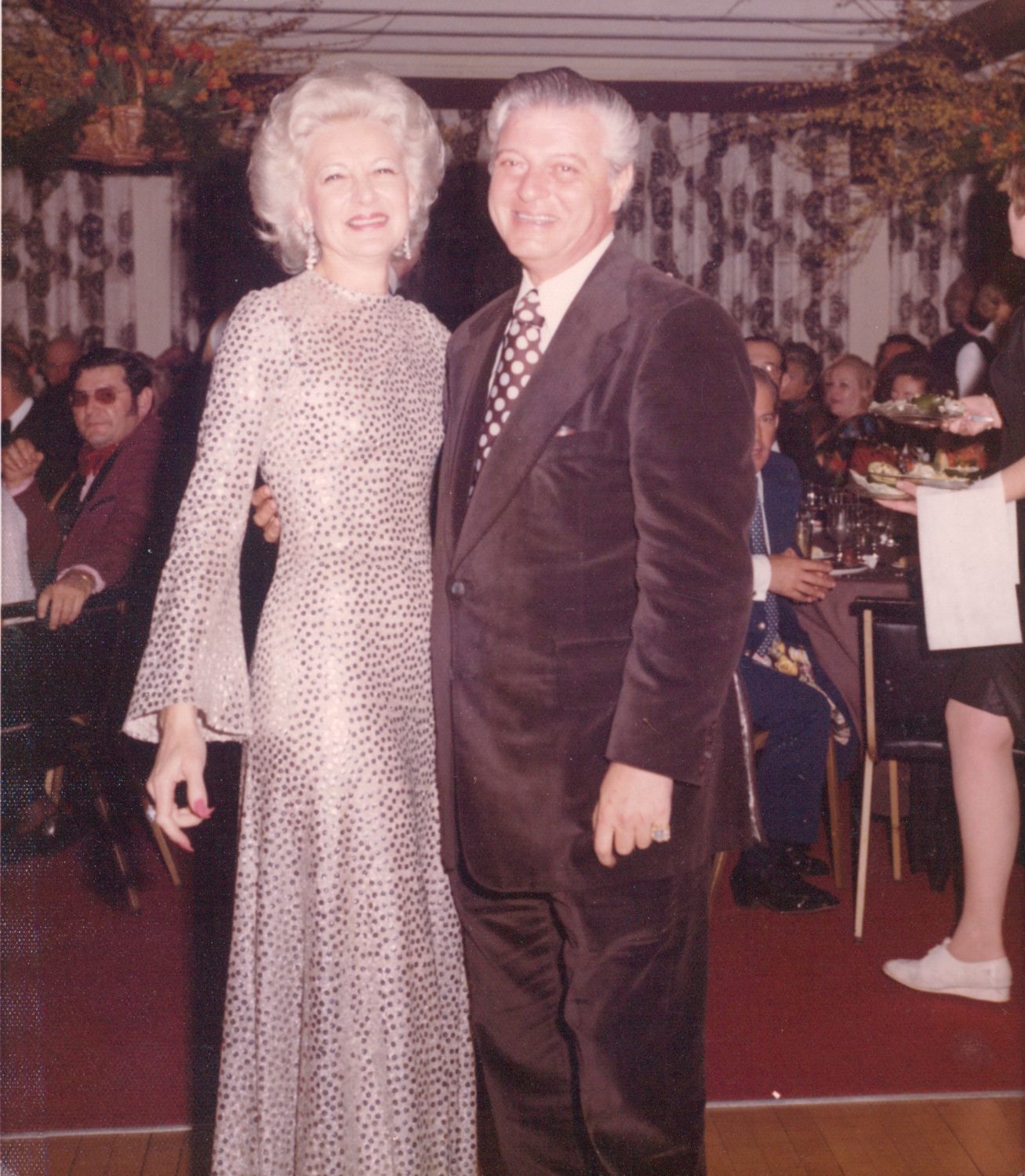
Rosalie & Bert Kavy, Courtesy of Susan Kavy
Gracefully appointed apartment buildings, often six stories, were complemented with elegant names that added distinction beyond just another number. They granted prestige over the crowded tenements that 1930s and 1940s-era residents and their parents’ generation might have experienced. Beautifully written and illustrated prospectuses were distributed to newcomers. An excerpt on Longfellow Hall, featuring stately brick and stone pilasters and urns, as well as a portico and brick quoins and archways, read, “This new elevator apartment house, modern up to the minute, situated in pleasant, broad-lawned Forest Hills, a community renowned for its beautiful gardens and shade trees, and its gracious, finely built private homes. Here is all the beauty and charm of a fine old country village.” Besides the convenience to the Queens Boulevard-8th Avenue subway 75th Avenue express station, prospective tenants learned about complete shopping facilities, motion picture theaters, restaurants, and schools. It then read, “Country life suggests outdoor sports, and Longfellow Hall is ideally located for sport lovers. Seven fine golf courses lie within five miles. The West Side Tennis Club, Seminole Club and scores of public tennis courts are nearby. Forest Park, with its miles of picturesque bridle paths, is at hand for the equestrian, and Grand Central Parkway, running direct to Jones Beach and other Long Island playgrounds, is just at the door.” It continued, “You will find a new zest in life at Longfellow Hall.”
“Designed to provide more in the way of comfort, greater luxury, and convenience, rare architectural beauty and dignity, these are the conditions which make living here indeed a pleasure. And all of this at a reasonable rental,” read a prospectus for Berkeley Plaza, which offers spacious Jr. 3 to 4 ½ rooms. It featured floor plans with captioned images and illustrations to engage the viewer, and depicted a garage with an automobile making its way, a modern kitchen arrangement, a complete Bendix-equipped laundry, and a recreation room (with ping-pong and billiards). Accompanying the graceful garden novelty was a statement, “This building will contain a well landscaped center garden, affording a beautiful view. The garden will be well kept, and insures an inspiration for serene living.” Marketable features also entailed a 24-hour doorman, dining galleries with wrought iron railings, chromium bathroom and kitchen fixtures, all rooms off a foyer, concealed radio outlet, a master antenna system, cross-ventilation, arched doorway openings, Colonial electric fixtures, more closets than rooms, built-in bookshelves, and dark rooms for camera fans.
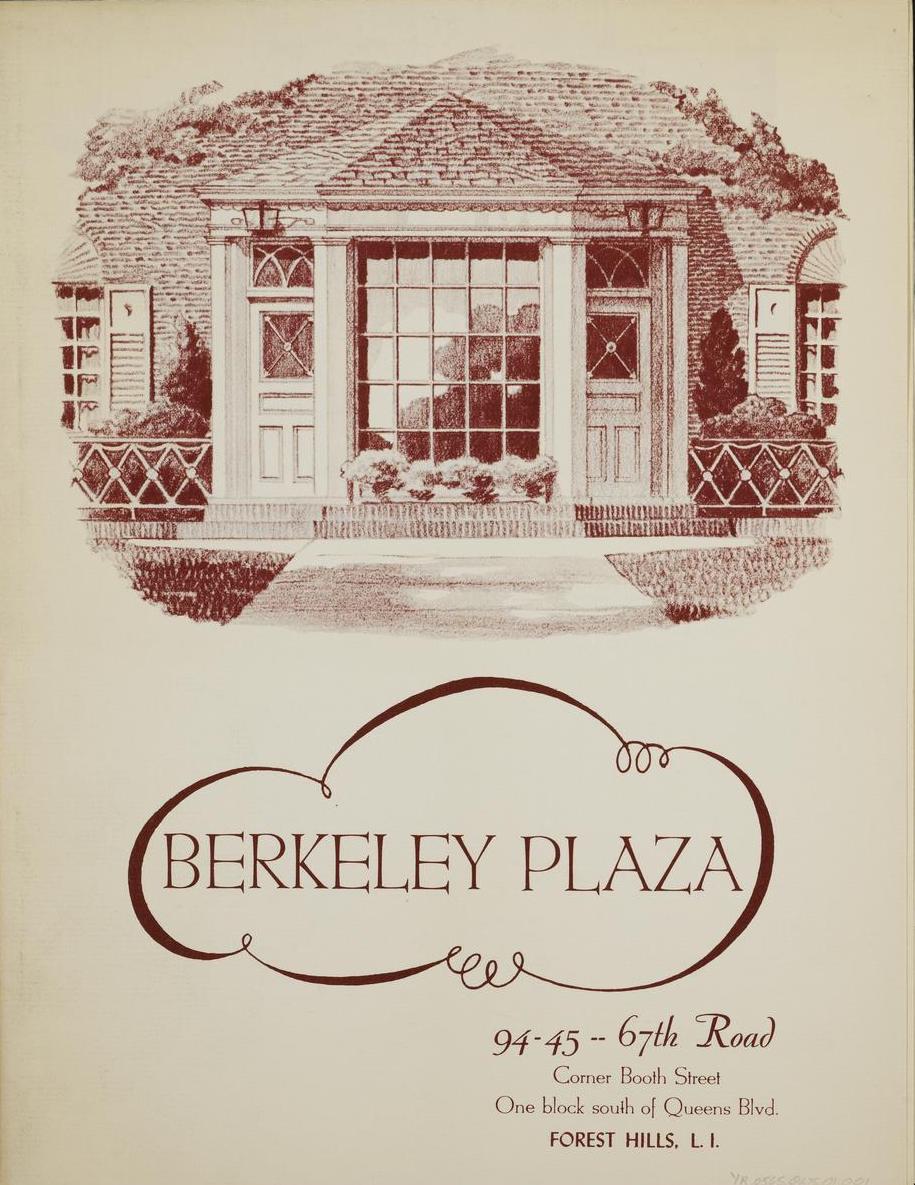
Colonial splendor
A Rego Park standout featured a façade rendering in the July 14, 1940 edition of the Brooklyn Eagle read, “Princeton Gardens apartment, the new 400-family apartment house located at 89-11 63rd Drive, Forest Hills, is renting rapidly, the managing agent reports. The four-unit development was built by David Minkin from plans by Kavy and Kavovitt, architects.”
Some achievements made newcomers feel as if they were exploring an English garden suburb. Such was the case at Rego Park’s unique Tudor Gothic Kensington Arms. Few and far between were developments erected as a group, heightening a sense of urban planning. “Presenting a sister house to the Devonshire Arms, which we had the pleasure of building last year across the street… Now we are proud to display to the public the Kensington Arms with its English architectural appearance and good careful construction,” read a prospectus. Location was also essential. “The house is situated on a high hill and a corner with picturesque surroundings makes the back of the house have the pleasure of seeing very clearly and visibly the Trylon and Perisphere of the New York World’s Fair of 1939, which represents the trademark of the World of Tomorrow of the Fair. The cooperative park with the Devonshire Arms assures the tenants of Kensington Arms privacy and comfort for their families with our colorful park benches and Miami Beach Steel Sun chairs. The city playground near to the front of the house with handball courts and other athletic facilities adjacent to the school (PS 139) is a very attractive asset to our tenants.”
In 1964, a contained city-like development became Yorkshire Towers at 305 East 86th Street, where every unit featured terraces. The lobby would feature oak paneling, terrazzo, and murals evoking old Spain. Other attractions would include an Olympic pool and social spaces to accommodate movies, lectures, dance and ethnic classes, and games.
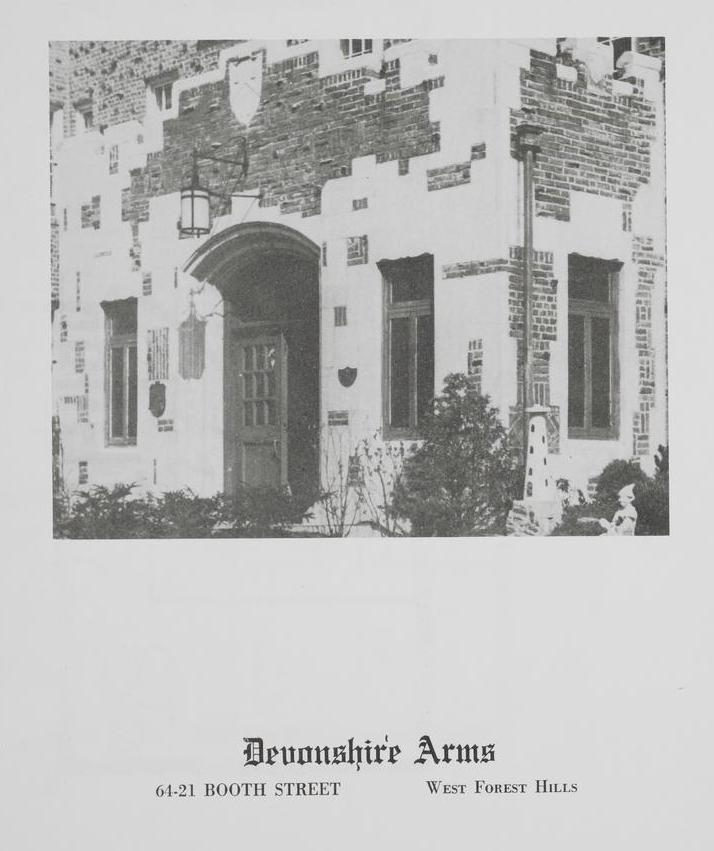
Tudor Gothic splendor
Fast-forwarding to 2026, architect Morris Kavy’s legacy is being preserved. His four grandchildren are Victor, Barry, and Lynda, who were born in Brooklyn, and Susan, who was born in Ossining. This columnist discovered Victor J. Kavy of West New York, NJ and Susan Kavy of Lagrangeville, NY, who value historic preservation of their grandfather’s buildings, and documenting an extensive family history and their grandfather’s voice, which should not be forgotten. Additionally, they are preserving the memory of their father, Bert Kavy (1925 – 2014) and mother, Rosalie Kavy (1927 – 2018). Gramps had eight grandchildren, which included another four from Bert’s brother, Gilbert.
Susan explained that three of her siblings are great antique and historic enthusiasts. “Victor once lived in a 1700s house up the street from my parents, Bert and Rosalie, and I live in an 1850s farmhouse. Gramps deserves to be recognized present day for everything he created so early on.”
Morris Kavy was born in Manhattan in 1898 and passed away in 1984 in Ossining. His wife was Fannie Radler (1903 – 1964). His parents were Vigdor Josef Kavovitz (Kavovitt) and Rebecca Ida Kavovitt (born Kaplan, 1868), who immigrated to New York from Minsk, Russia. Morris’ maternal grandparents, Dina and Joel Kaplan, were married in 1866 and immigrated to New York in 1906. His paternal grandparents were Bernard Kavovitz and Kate Kavovitz.
Around 1976, Susan interviewed Gramps, and his voice comes alive today through an audio recording. Morris lived on the Lower East Side and later resided on Washington Avenue and 180th Street in the Bronx. “I supported my family. I went to PS 64 in Manhattan and Morris High School. I had to work, so I went at night to Cooper Union. I graduated, got a job as a draftsman, and built myself up as chief draftsman. When I was 24, I got married and Grandma was 20. I met her at a social club.” He spoke English and learned Hebrew and Yiddish. Also at 24 while working, he could not earn much. “I thought I’m going to go out in business for myself as an architect, but I was too young to get clients who were building million-dollar propositions, so I grew a mustache and changed my name legally to Kavy. To make the firm look very important, I made the name Kavy & Kavovitt, Inc.”
Morris’ original last name was Kavovitt, which he shortened during a period of antisemitism. “There was antisemitism in the 1930s and 1940s in the city, and when clients would come, they would ask where’s Kavovitt (as in Kavy & Kavovitt), and Morris would say ‘I’m Kavy. Kavovitt is in Europe,’” explained Victor.

Architect Morris Kavy on right receives honorary building shovel, Courtesy of Susan Kavy
Morris Kavy was a genuine family man with a hands-on approach. Susan reminisced, “My grandfather built a house at 14 Grace Lane in Ossining in 1953. My grandparents invited my parents to stay for the summer with the three children. Because my parents loved it and my grandparents were so generous, they gave the house to my parents. They still stayed at the house when they visited, but then my grandmother died at a young age. My grandfather remarried and built a house next door.”
In addition to being a people’s person who had good rapport with everyone, Susan remembers Gramps as “the brain.” His largest project was Brooklyn’s Vanderveer Estates, which she considers the Peter Cooper Village and Stuyvesant Town of Brooklyn with its 59-building complex, completed in 1950 for working-class families. Among its residents was Barbra Streisand. It has since been renamed Flatbush Gardens. Upon sharing the Forest Hills and Rego Park prospectuses, she said, “I am fascinated that my grandfather had so much talent at such a young age. Everyone has a story, but we just didn’t talk about it. The façades and interiors are fantastic! We were only privy to when Gramps decided to design, build, own, and manage Vanderveer in Brooklyn. It was a total surprise to the four siblings that there was a life before that. We knew nothing about his designing buildings before Vanderveer.”
Besides close-knit developments, Susan recalled her father’s close-knit relationship. She explained, “He attended Georgia Tech to study architecture, but Gramps called him home to help with the business of Vanderveer, and he left college a semester shy of graduation. My dad met my mom in Georgia. He was 17, and she was 15. They met at an AEPI Fraternity party. And that was it for 70 years. They held hands all day long, and spooned every night.”
Susan feels inspired by how philanthropic Gramps was, in addition to observing that trait from her parents, and today, she and her partner, Tory Klose, are humanitarians. “They dedicated themselves to mostly Jewish organizations. My grandfather helped build synagogues in NYC, and along with dad and my uncle (his younger brother), the one we attended, Congregation Sons of Israel in Briarcliff Manor.”
Susan, who adored Gramps and frequently visited, reminisced, “He would drive me to work in his limo, and we held hands all the way. He was more than generous with me and the others while growing up. He took the cousins to the toy store every Sunday. We had a great time. We all went to the circus, and because my grandfather knew someone there, we received the royal treatment. I was absolutely born into the right family. The kids’ claim to fame is that we all went to college on the quarters from the washing machines!”
She is also grateful for being raised with parents who she recalls as a terrific handsome couple. “We traveled, went to Broadway shows, and had a pool and tennis court. Mom loved to entertain, and she was excellent at it. She was a southern belle, who easily could have been CEO of a Fortune 500 company. I am lucky to take after her in the entertainment and philanthropy areas.”
Enter the world of Victor Kavy, who owns and operates a third-party management company in Manhattan, Metro Hudson Property Mgt Group LLC. “It’s wonderful to see a revival of our grandfather’s creative accomplishments. I truly thought that Gramps would be lost to history, but the resurrection of his talent and vision is just wonderful,” he said.
David Minkin, who developed many buildings in Forest Hills and Rego Park, was also a builder with whom Gramps maintained an ongoing relationship with. Victor explained, “Gramps was also the architect for Fred Trump and Samuel LeFrak, and many of the developers of the 1940s through the 1960s. At the same time, he decided, ‘Why design for others, when I can design and build myself?’ and so he did.” Victor pointed out that Kavy & Kavovitt was a last surviving general business corporation architectural firm in New York, which is not permitted today.
Victor recalls Gramps’ concepts as simple. “Maximize use of interior space laid out in a cohesive useful format. He was a master of flow and space utilization.” He also shared that his grandfather liked being under the radar, which was why only insiders of the industry used him, although his contacts were endless. “Gramps had a presence about him that instilled trust and faith. His word was his bond. A handshake was as good as a contract,” he continued.
Victor also shared one of Gramps’ and his father’s favorite expressions, which he uses to this day when asked a question that is impossible to respond to: “My crystal ball is out for repair.”
Real estate runs in the family. Victor, the oldest of four siblings, explained that the family business was solely confined to Brooklyn. The base of operation was Faymor Development, symbolic of their grandmother Fay and grandfather Morris. “My role was the day-to-day management of the Brooklyn and Staten Island properties designed and built by our grandfather and those in New Rochelle. Our offices were first on Court Street, and then at 185 Montague Street. Morris was always at 44 Court Street.” He continued, “Gramps was the architect and led the development arm; dad and his brother, Gilbert, ran the financial division of Faymor Development, and later, after Gramps died, Grace Development.”
“Gramps was from a school of men that does not exist anymore. These men were of a different breed, who had vision and how to get things done,” said Victor, who shared a favorite story. “During one of my inspections of the garages at Vanderveer Estates, I found over 50 barrels of rusted nails. I asked why and discovered that during the war, there was a shortage of nails for construction. Morris heard of a shipment coming into the city. He secured a tugboat, went out to the ship, bought the entire shipment before the ship came to port, and was the sole supplier after that.”
A larger than life feeling is bound to surface while walking in the spirit of one’s ancestors. “I had my real estate management firm in Westchester, where I ran approximately 50 buildings. I take over a building in Mount Kisco. When I’m walking the site, it feels familiar. When I get back to my office, I find the rendering depicting the three buildings as one of our grandfather’s designs. Sometimes it’s a smaller world than we think.”

Morris Kavy with his wife Fay, Courtesy of Susan Kavy

Wells Cox is a digital media enthusiast and writer passionate about social media trends and online engagement. As the creator of MT LIVECHAT, he shares insights, tips, and updates to help users navigate the ever-evolving digital landscape.